
A useful building maintenance schedule separates routine preventive work from compliance inspections and urgent repairs. Assign every task to a named area or asset, record the required frequency, and nominate the person responsible for completion.
Plan maintenance around specific building systems
- Prevents costly breakdowns: Routine inspections catch small issues, such as a worn seal or a minor leak, before they turn into expensive emergency repairs.
- Extends the life of building systems: Regular servicing of HVAC, electrical, and plumbing systems helps them run efficiently for longer, delaying costly replacements.
- Improves safety and compliance: Scheduled checks on fire alarms, extinguishers, and emergency exits help a property stay compliant with local safety codes.
- Keeps tenants and occupants satisfied: A well-maintained building reduces complaints and disruptions caused by unexpected equipment failures.
- Supports better budgeting: Knowing what maintenance is coming up makes it easier to plan and set aside funds in advance rather than scrambling for emergency repair costs.
- Creates accountability: Assigning tasks to specific contractors or staff members makes it clear who is responsible for each job and when it is due.
Worked example: For an apartment building, log monthly HVAC-filter checks, quarterly roof-drain inspections, and annual emergency-light testing as separate recurring tasks, each with a last-completed date and next due date.
Check before use: Adapt intervals to equipment manuals and local requirements; a generic schedule cannot establish legally required inspection frequencies. Keep evidence of completed checks and escalate overdue safety-critical work.
For a related planning task, see 3 Free Facility Maintenance Checklist Templates and 4 Maintenance Templates.
What’s Included in the Building Maintenance Schedule Template
Both templates on this page are organized around the core information a maintenance plan needs:
- Task or system name: The specific item being maintained, such as HVAC, roofing, plumbing, elevators, or fire safety equipment.
- Maintenance type: Whether the task is routine, preventive, or emergency maintenance, so priorities are clear at a glance.
- Frequency: How often the task needs to be performed — weekly, monthly, quarterly, or annually.
- Responsible party: The contractor, technician, or staff member assigned to complete the task.
- Due date and completion tracking: A place to record when a task is scheduled and confirm once it has been completed.
- Notes column: Space to record findings, part replacements, or follow-up actions needed.
Who Should Use This Template?
This template is built for anyone responsible for keeping a building in working order, including:
- Property owners and landlords managing residential or commercial rental properties.
- Facility managers overseeing maintenance across office buildings, warehouses, or institutional facilities.
- Contractors and maintenance companies who need a clear plan to share with clients.
- Homeowners’ associations coordinating maintenance for shared building systems and common areas.
How to Start Using the Template in 3 Simple Steps
- Step 1 — Download the template: Choose either version below and save it to your computer.
- Step 2 — List your building’s systems and tasks: Add every recurring maintenance item relevant to your property, along with how often it needs attention.
- Step 3 — Assign and track: Set due dates, assign each task to a contractor or team member, and update the sheet as work is completed.
Building Maintenance Schedule Template vs. Manual Tracking
Some property owners still rely on memory, sticky notes, or scattered emails to track maintenance needs. This works only briefly, because building systems involve dozens of components with different service intervals, and it is easy to lose track of what was last checked and when. A structured template solves this by keeping every task, date, and responsible party in one consistent place, so nothing depends on anyone remembering. It also creates a searchable history: when a system eventually needs replacement, you can look back and see exactly how it was maintained over its lifetime, which is useful for warranty claims, insurance, and future budgeting decisions.
Customizing the Template for Your Property
Every building is different, so the templates on this page are meant to be adapted rather than used exactly as-is. You might add a column for estimated cost per task, a priority level to flag urgent items, or separate tabs for different buildings if you manage more than one property. Because the templates use a standard, editable format, these changes take only a few minutes and require no special software skills — just enough familiarity with adding columns and entering data to shape the sheet around how your team actually works.
Common Mistakes to Avoid
- Only reacting to breakdowns: Waiting until something fails is almost always more expensive than scheduled preventive maintenance.
- Skipping documentation: Without a written record, it is easy to lose track of what was serviced and when.
- Ignoring seasonal tasks: Items like gutter cleaning or HVAC servicing before summer and winter are easy to forget if they are not scheduled in advance.
- Not assigning clear ownership: A task with no named owner is far more likely to be missed.
- Failing to update the schedule: A maintenance plan that is not kept current quickly becomes unreliable.
Tips to Get the Most Out of Your Maintenance Schedule
- Group tasks by system. Organizing by HVAC, plumbing, electrical, and structural items makes the schedule easier to scan and manage.
- Set reminders ahead of due dates. A few days’ notice gives contractors time to schedule the work without last-minute pressure.
- Keep a maintenance history. Recording past work helps identify recurring problems and plan for eventual replacements.
- Review the schedule seasonally. Update it as new equipment is installed or building needs change.
- Share it with your maintenance team. A shared, up-to-date schedule keeps everyone aligned on what is due and when.
Download building maintenance schedule templates here
Building Maintenance Schedule Example
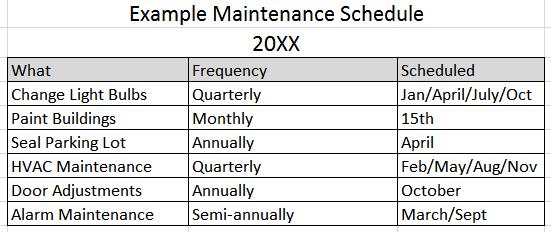

Building Maintenance Schedule

Frequently Asked Questions
Is this building maintenance schedule template free to download?
Yes, both templates on this page are completely free to download and use for personal or professional property management.
Can I edit the template after downloading it?
Yes. Both templates are fully editable, so you can add, remove, or rename columns, insert your own tasks, and adjust the layout to fit your property.
What software do I need to open it?
The templates open in Microsoft Excel and also work in free alternatives such as Google Sheets or LibreOffice Calc.
How often should a building maintenance schedule be reviewed?
It’s best to review the schedule at least quarterly, and update it immediately whenever new equipment is installed or a service interval changes.
Can I use this for both residential and commercial properties?
Yes, the layout works for residential buildings, commercial properties, and mixed-use facilities alike, since every task and interval is fully customizable.
Does the template cover emergency maintenance as well as routine tasks?
Yes, you can use the maintenance type column to separate routine, preventive, and emergency maintenance so priorities stay clear.
Can multiple team members use the same schedule?
Yes. If you save the file to a shared drive or cloud storage service, your whole maintenance team can view and update the same schedule.

You must be logged in to post a comment.