
A periodic table is useful when element names, symbols, atomic numbers and mass values are legible and accurate. Decide whether learners need group labels, colour-coded chemical families, electron configurations or a plain assessment worksheet.
Use the periodic table as a scientific reference, not only a poster
- Saves preparation time: A ready-made layout means you don’t have to manually arrange 118 elements from scratch.
- Improves study efficiency: A clear, well-organized chart makes it easier to memorize element groups, properties, and trends.
- Supports classroom teaching: Teachers can print or display a professional periodic table without needing design skills.
- Offers formatting flexibility: Editable versions let you highlight specific element groups or add custom notes.
- Works across skill levels: From beginner-friendly basic charts to detailed versions with atomic properties, there’s an option for every need.
- Print-ready design: Each template is formatted to look clean and legible whether printed or viewed digitally.
Worked example: A classroom chart might highlight alkali metals in group 1 and noble gases in group 18, whereas an exam practice sheet may intentionally leave selected entries blank. Different formats serve different teaching goals.
Check before use: Check that element 118, oganesson (Og), is present, and confirm the reference edition and rounding convention for atomic masses. Print at a size that leaves small symbols readable.
For related resources, see 12+ FREE Class Schedule Templates [WORD, EXCEL, PPTX] and 5 Multiple Choice Test Templates.
What’s Included in the Periodic Table Template
- All 118 chemical elements: Arranged by atomic number in the standard periodic table structure.
- Element symbols and names: Clearly labeled for quick identification.
- Atomic number and weight fields: Key reference data included in the more detailed templates.
- Color-coded element groups: Many templates visually distinguish metals, nonmetals, and metalloids.
- Clean, readable layout: Designed for clarity whether used as a study aid or a classroom poster.
- Editable format: Word and Excel versions can be adjusted to highlight specific elements or add annotations.
Who Should Use These Templates?
- Chemistry students studying for exams or working through coursework that requires quick element reference.
- Teachers and professors who need a printable chart for classroom walls or handouts.
- Science tutors helping students understand element groups and periodic trends.
- Homeschooling parents teaching chemistry basics at home.
- Lab technicians and researchers who want a quick desk reference for chemical properties.
- Science enthusiasts who enjoy exploring themed or creative takes on the periodic table.
How to Start Using the Template in 3 Simple Steps
- Step 1 — Choose a template style: Browse the thirteen options below and select the one that fits your purpose, whether that’s a detailed reference chart or a simpler study version.
- Step 2 — Customize if needed: Add highlights, notes, or adjust labels in the editable Word or Excel versions.
- Step 3 — Print or use digitally: Print the chart for classroom or study use, or reference it directly on your screen.
Basic vs. Detailed Periodic Table Templates
This collection includes both simplified and highly detailed versions, and choosing between them depends on your purpose. A basic periodic table template lists element symbols, names, and atomic numbers in a clean, uncluttered layout, which works well for younger students or quick visual reference. A detailed template, by contrast, includes additional atomic properties such as electron configuration, atomic mass, and element categories, making it more suitable for advanced coursework or laboratory reference. Reviewing both styles before choosing helps ensure you get a chart that matches your actual needs rather than one that’s either too sparse or too overwhelming.
Customizing the Template for Your Needs
These templates are meant to be a flexible starting point rather than a fixed, unchangeable chart. You might highlight specific element groups relevant to a current lesson, add color-coding for metals, nonmetals, and metalloids, include extra notes about specific elements you’re studying, or adjust the overall size and layout for printing as a poster. Since the templates are provided in editable Word and Excel formats, these kinds of adjustments take only a few minutes.
Choosing the Right Format: Word, Excel, or PDF
Each format suits a different use case. Word versions are the easiest to edit freely, making them a good choice if you plan to add notes, highlight sections, or adjust the layout significantly. Excel versions work well if you want to build additional reference tables or sortable lists of element data alongside the visual chart. PDF versions are best once your chart is finalized, since they preserve exact formatting and print consistently, making them ideal for a final classroom handout or study poster.
Common Mistakes to Avoid
- Using an outdated chart: Make sure the template includes all currently recognized elements, including recently named ones.
- Overcomplicating a basic reference: For quick study use, a simpler chart is often easier to read than one packed with extra data.
- Ignoring print scaling: Periodic tables have many small cells, so check print settings to ensure text remains legible.
- Skipping color-coding: Color distinctions between element groups make patterns much easier to spot and remember.
- Not verifying accuracy: Double-check atomic numbers and symbols, especially in customized or annotated versions.
Tips to Get the Most Out of Your Periodic Table Template
- Print a large format version for classroom walls so students can reference it easily from their seats.
- Use color-coding consistently to reinforce element group patterns during study sessions.
- Keep a digital copy handy on your phone or tablet for quick reference outside the classroom.
- Combine with flashcards for more effective memorization of element symbols and properties.
- Update your version periodically to reflect any newly recognized elements or naming changes.
Understanding the History Behind the Periodic Table
The periodic table as we know it today traces back to the work of Russian chemist Dmitri Mendeleev, who is widely credited with organizing elements by atomic weight and predicting the existence of then-undiscovered elements based on gaps in his table. Understanding this history can add useful context when studying the table, since it explains why elements are arranged the way they are and how the periodic law, the principle that element properties repeat in a predictable pattern, came to be one of the foundational concepts in chemistry. Several of the templates in this collection work well as a starting point for lessons that cover this historical background alongside the table itself.
Using Themed Periodic Tables for Engagement
Beyond standard reference charts, this collection also includes a few creative, themed variations, such as a periodic table of beer styles, that reimagine the familiar grid layout for a different subject entirely. These themed versions can be a useful teaching tool for introducing the concept of a periodic table’s structure in a lighter, more approachable way before transitioning to the standard chemistry version. They also work well as a fun, low-pressure way to help students understand how the grid format itself, rows and columns organized by shared characteristics, can be applied to categorize almost anything.
Preparing a Periodic Table for Exams and Assessments
Many chemistry courses allow or even require students to bring a periodic table into exams, since memorizing every atomic weight and configuration isn’t the point of most assessments. If you’re preparing a version for exam use, it’s worth checking with your instructor about what level of detail and annotation is permitted, since some exams restrict color-coding or handwritten notes on the chart. A clean, unmarked printable version works well as a starting point, and if annotations are allowed, focusing on a small number of high-value additions, such as marking commonly confused element symbols, tends to be more effective than crowding the page with extensive notes that are hard to scan quickly under time pressure.
Building a Quick Reference System with Multiple Templates
Rather than relying on a single periodic table format, many students and educators find it useful to keep two or three different versions on hand for different purposes: a detailed chart with full atomic properties for in-depth study, a simplified version for quick visual reference, and a blank or partially blank version for practice memorization exercises. Having this small library of formats ready, using several of the templates in this collection together, makes it easier to match the right tool to the task at hand rather than trying to force one all-purpose chart to serve every study situation.
Displaying a Periodic Table in a Classroom or Lab Setting
A well-placed periodic table poster can serve as a passive learning tool that students absorb over time simply by seeing it regularly, which is part of why so many classrooms and labs keep one prominently displayed. When printing one of these templates as a large wall poster, consider the viewing distance from typical seating and choose a template with sufficiently large, high-contrast text so it remains legible from across the room. Laminating a printed copy is also worth considering for a lab setting, where the poster may be exposed to spills, humidity, or frequent handling, since it extends the life of the printed chart considerably compared to a standard paper copy.
Bonus template: Periodic-table reading practice worksheet
Use this short worksheet alongside a current reference table. It tests how to read an element entry rather than asking students to memorize a decorative layout.
Download the editable Word template
Download Periodic table reading worksheet (.docx)
Open in Microsoft Word and replace the placeholders. Text and tables are editable; customize the colors and wording for your needs.
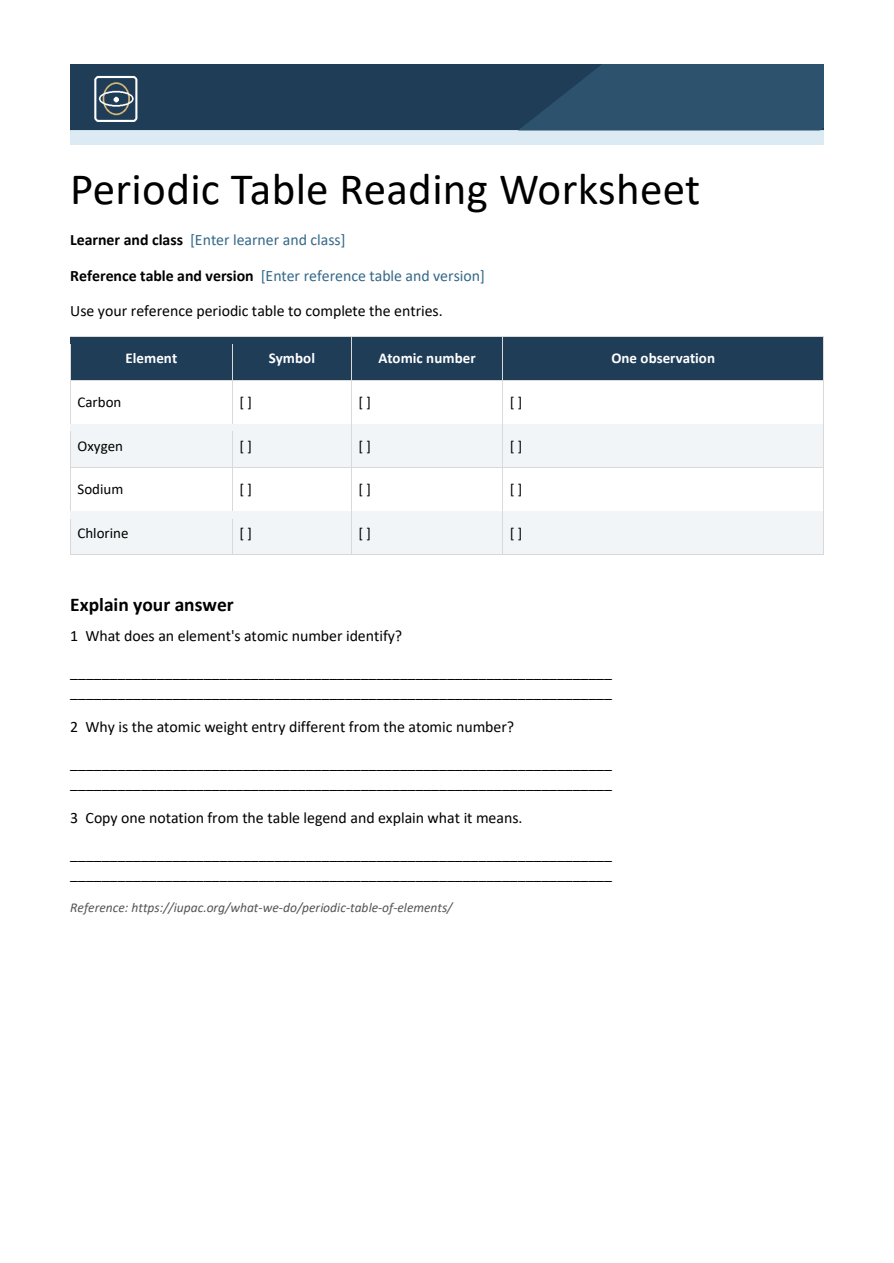
Set up the record
- Learner: [name]
- Reference table / version: [source]
| Prompt | Learner answer |
|---|---|
| Find carbon: write its symbol and atomic number | |
| Find oxygen: write its symbol and atomic number | |
| Find sodium: write its symbol and atomic number | |
| Find chlorine: write its symbol and atomic number | |
| Explain why the atomic number and atomic-weight entry are different |
How to use this template
- Ask learners to find each element on the reference table before checking the answer key.
- Discuss that atomic number identifies proton count; the standard atomic-weight entry is a different quantity.
- Use the reference table’s own legend for brackets, intervals and other notation instead of assuming every displayed mass is an integer.
Worked example: Answer key: carbon C, 6; oxygen O, 8; sodium Na, 11; chlorine Cl, 17. Keep this key separate from an assessment copy.
Check before use
- Use case-sensitive symbols: Na, not NA.
- Do not round an atomic weight to obtain an atomic number.
- Check the reference source and legend before printing.
Reference: IUPAC periodic table and reference information.
Download Periodic Table Templates Here
Professional Periodic Table Template

Periodic Table Template with Atomic Properties of Elements

Sample Periodic Table Template

Periodic Table Excel Template

Official Periodic Table Template

Catchy Periodic Table of Elements Template

Basic Periodic Table Template

Periodic Table of Elements Template WORD

Periodic Table of Beer Styles Template

Special Periodic Table Template

Example Periodic Table Template

Colorful Periodic Table of Elements Template

Editable Periodic Table Quiz Template

Frequently Asked Questions
Are these periodic table templates free to download?
Yes, all thirteen periodic table templates on this page are free to download and use.
Which file formats are available?
The templates are available in Word, Excel, and PDF formats, so you can choose whichever suits your editing and printing needs.
Can I customize these templates with my own notes or highlights?
Yes, the Word and Excel versions are fully editable, letting you add color-coding, notes, or highlight specific elements.
Are these templates suitable for classroom use?
Yes, several templates are designed as large, clear reference charts well suited for printing as classroom posters.
Do these templates include all currently known elements?
Yes, the templates include all 118 recognized chemical elements arranged by atomic number.
Do I need Microsoft Office to use these templates?
Most templates are built for Word or Excel but also open in free alternatives such as Google Docs, Google Sheets, or LibreOffice.
Which template should I choose for exam study?
A detailed template with atomic properties works well for in-depth study, while a simplified version suits quick visual reference.

You must be logged in to post a comment.