
A job proposal can describe a new position, role change or project-based engagement. It should explain the organisational need, proposed responsibilities, expected outcomes, estimated cost and decision requested.
Bonus template: New-role business case template
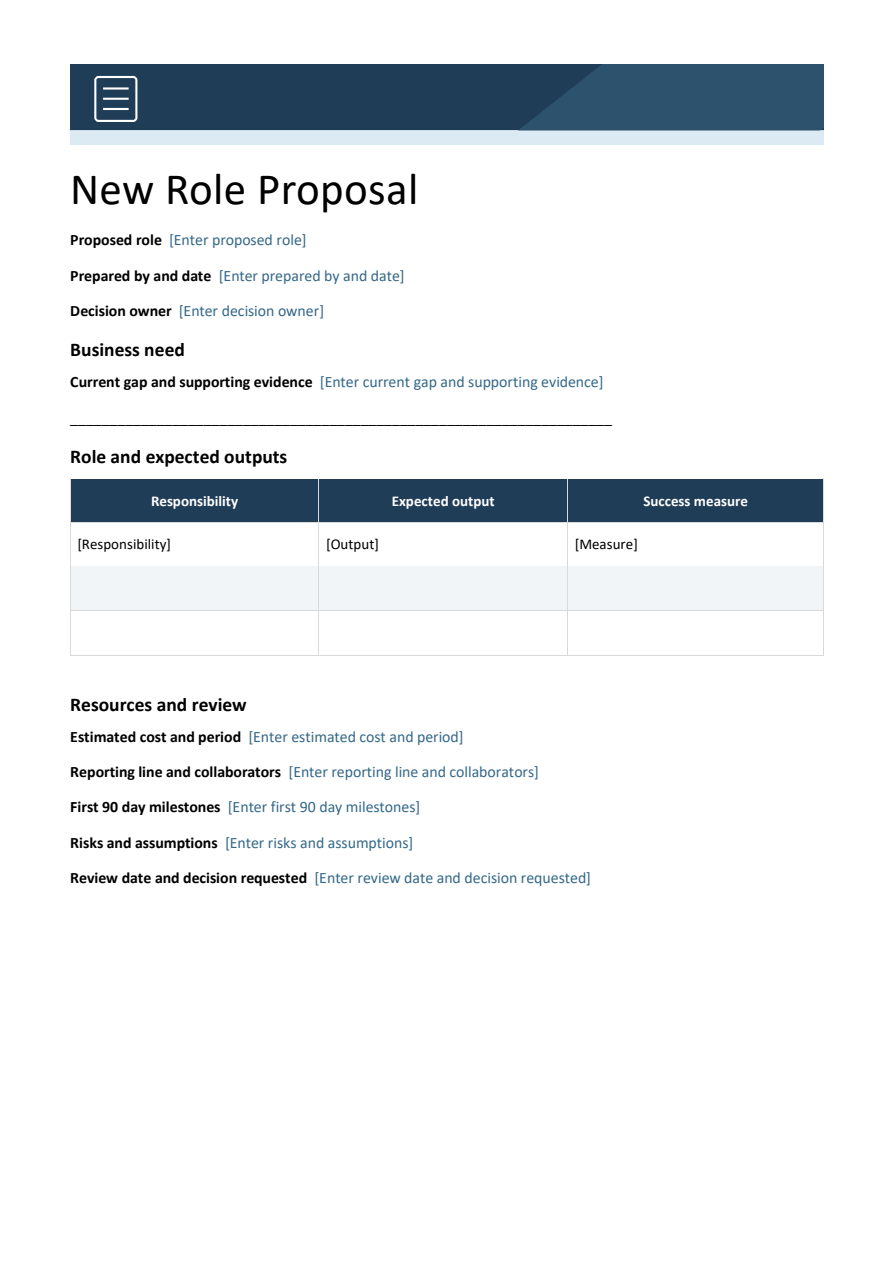
Use this outline to propose a new position or a change in responsibilities. It should help the decision-maker judge the organizational need, cost and expected result.
Download the editable Word template
Download New role proposal (.docx)
Open in Microsoft Word and replace the placeholders. Text and tables are editable; customize the colors and wording for your needs.
Copy and personalize this wording
PROPOSED ROLE: [title]
Decision requested: [create role / revise role / approve trial]
Current problem: [specific gap and supporting evidence]
Responsibilities: [three to five defined responsibilities]
Expected outputs: [measurable outputs]
Reporting line and collaborators: [roles]
Resources and estimated cost: [basis and period]
First 90 days: [milestones]
Success review: [date; measures; reviewer]
Assumptions and risks: [details]
Next decision: [owner; date]
How to use this template
- Describe the work that is currently missing or delayed.
- Estimate costs on a stated basis rather than promising that the role pays for itself.
- Offer a defined review point, especially when demand or responsibilities are still uncertain.
Worked example: A proposed customer-onboarding coordinator would maintain the handover checklist, schedule kickoff calls and report unresolved handoffs. A 90-day review would compare missed handovers and response times with the starting baseline.
Check before use
- Avoid duplicating an existing role without explaining the boundary.
- Name who owns the hiring or role-change decision.
- Keep expected outcomes distinct from guaranteed results.
Turn a job proposal into a clear request and benefit
Worked example: For a new inventory coordinator role, identify frequent stock discrepancies, the work the employee would own and how success would be measured after the first three months.
Check before use: Tailor the format to the recipient and distinguish an internal proposal from an employment offer or binding contract. Review staffing costs and reporting lines before approval.
For related resources, see 24+ Printable Proposal Form Templates and 15 Practical Sales Plan Templates [WORD & EXCEL].
What’s Included in the Job Proposal Template
Introduction section: Space to briefly introduce yourself and state your purpose for writing. Qualifications summary: A field for outlining your relevant skills, experience, and achievements. Value proposition: A section explaining specifically how you could benefit the company or solve a problem they face. Contact information: Fields for your name, phone number, email, and other relevant details. Call to action: A closing section inviting the reader to schedule a conversation or interview. Professional formatting: A clean, business-appropriate layout suitable for formal correspondence.
Who Should Use These Templates?
Job seekers pursuing executive or specialized positions that benefit from a more detailed pitch. Career changers who need to explain how their transferable skills apply to a new field. Freelancers and consultants pitching their services to a potential client or employer. Recent graduates looking to stand out in a competitive entry-level job market. Professionals targeting unadvertised roles who want to introduce themselves proactively to a company. Sales and business development candidates demonstrating persuasive writing skills through the proposal itself.
How to Start Using the Template in 3 Simple Steps
Step 1 — Choose a template style: Browse the 3 options below and select the format that best fits your situation. Step 2 — Personalize your content: Add your qualifications, achievements, and a clear explanation of your value to the company. Step 3 — Review and send: Proofread carefully and send the proposal along with your resume to the potential employer.
Job Proposal vs. Cover Letter
While both documents accompany a job search, a job proposal and a cover letter serve somewhat different purposes. A cover letter typically responds to a specific, already-advertised job posting, briefly introducing your resume and expressing interest in that particular role. A job proposal, by contrast, is often more detailed and persuasive, making the case for why a company should consider you even for a position that hasn’t been formally advertised, by focusing heavily on the specific value you’d bring. Many job seekers use a cover letter for standard applications and reserve a full job proposal for higher-stakes situations, such as pitching for an executive role or approaching a company proactively.
Customizing the Template for Your Situation
This template is designed to be a flexible starting point rather than a fixed format. You can adjust the tone to match the company’s culture, emphasize different qualifications depending on the specific role, or restructure sections to highlight your strongest selling points first. Since the templates are provided in editable formats, most adjustments take only a few minutes and let you tailor the proposal to fit your particular career goals.
Choosing the Right Format
With 3 different templates available, choosing the right one depends on your industry and the tone you want to convey. A more traditional, formal design works well for corporate or executive roles, while a simpler, editable format offers flexibility for more creative or informal industries. Reviewing each option before committing to one can help you find the layout that best represents your professional brand.
Common Mistakes to Avoid
Being too generic: Avoid vague statements and instead be specific about the value you offer. Focusing only on yourself: Frame your qualifications around how they benefit the employer, not just your own goals. Skipping proofreading: Typos and grammatical errors can undermine an otherwise strong proposal. Making it too long: Keep the proposal concise and focused on your strongest points. Forgetting a clear call to action: Always end by inviting the reader to take the next step, such as scheduling an interview.
Tips to Get the Most Out of Your Job Proposal Template
Research the company thoroughly before writing so you can speak directly to their needs. Lead with your strongest qualification to capture attention early in the document. Quantify your achievements with specific numbers or results whenever possible. Match the tone of the proposal to the company’s culture and industry. Follow up a week or two after sending if you haven’t heard back.
Structuring a Persuasive Opening Paragraph
The opening paragraph of a job proposal carries significant weight, since it’s often what determines whether the reader continues to the rest of the document. Leading with a brief, confident statement about what you can offer, rather than a generic greeting, immediately signals that the proposal is worth reading closely. Candidates who reference something specific about the company, such as a recent initiative or a known challenge they’re facing, tend to capture attention more effectively than those who open with only a general introduction of themselves.
Demonstrating Value Through Specific Examples
Simply listing skills and job titles rarely makes a job proposal persuasive on its own; what makes the difference is connecting those qualifications to specific, concrete examples of results you’ve delivered in the past. Describing a particular challenge you solved, a process you improved, or a measurable outcome you achieved gives the reader tangible evidence of what you could bring to their organization. Framing these examples in terms of the employer’s likely priorities, such as cost savings, efficiency, or revenue growth, makes the connection between your background and their needs even clearer.
Following Up After Submitting a Job Proposal
Sending a job proposal is rarely the final step in the process, and a thoughtful follow-up can meaningfully increase your chances of getting a response. Waiting roughly one to two weeks before following up strikes a reasonable balance between showing initiative and respecting the recipient’s time. A brief, polite follow-up message that restates your interest and offers to answer any questions keeps you visible without coming across as overly persistent, and it often prompts a reply from employers who simply hadn’t gotten around to responding yet.
Adapting the Template for Different Industries
While the core structure of a job proposal stays consistent, the tone and emphasis often need to shift depending on the industry you’re targeting. A proposal aimed at a creative agency might benefit from a more distinctive voice and visual presentation, while one aimed at a financial or legal firm typically calls for a more conservative, formal tone throughout. Reviewing examples of communication style within your target industry before finalizing your proposal can help you strike the right balance between standing out and fitting the expectations of that particular field.
Pairing Your Job Proposal With a Strong Resume
A job proposal works best as a companion to a well-prepared resume rather than a replacement for one, since employers often still expect a traditional summary of your work history and credentials. Making sure the two documents complement each other, rather than repeating the same information word for word, gives the reader a fuller picture without feeling redundant. Using the proposal to expand on the narrative and context behind your resume, such as why you’re pursuing this particular opportunity, often creates a more compelling overall submission than either document could achieve alone.
Formatting Considerations for a Professional Presentation
Beyond the content itself, the visual presentation of a job proposal plays an important role in how seriously it’s received by a potential employer. Consistent fonts, clear section headings, and generous spacing all contribute to a document that feels organized and easy to read at a glance. Saving and sending the completed proposal as a PDF, rather than an editable Word document, helps preserve the formatting exactly as intended regardless of what software the recipient uses to open it.
Get Free Job Proposal Templates Here
Sample Job Proposal Template


Blank Job Proposal Template

Free Editable Job Proposal Example

Frequently Asked Questions
Are these job proposal templates free to download?
Yes, all 3 job proposal templates on this page are free to download and use.
Can I customize the fields on these templates?
Yes, since the templates are fully editable, you can add your own qualifications, achievements, and contact details.
Is a job proposal the same as a cover letter?
Not exactly. A cover letter usually responds to an advertised job, while a job proposal is often a more detailed, persuasive pitch that can be sent proactively.
Should I send a job proposal along with my resume?
Yes, a job proposal works best as a companion to your resume rather than a replacement for it.
How long should a job proposal be?
It should be concise and focused, typically one page, covering your strongest qualifications and value to the employer.
When should I follow up after sending a job proposal?
Waiting about one to two weeks before sending a polite follow-up message is generally a reasonable approach.

You must be logged in to post a comment.