
A facility checklist should differentiate safety-critical inspections from cosmetic upkeep and include location, task, due date, accountable person and completion evidence.
Bonus template: Facility inspection exception and follow-up sheet
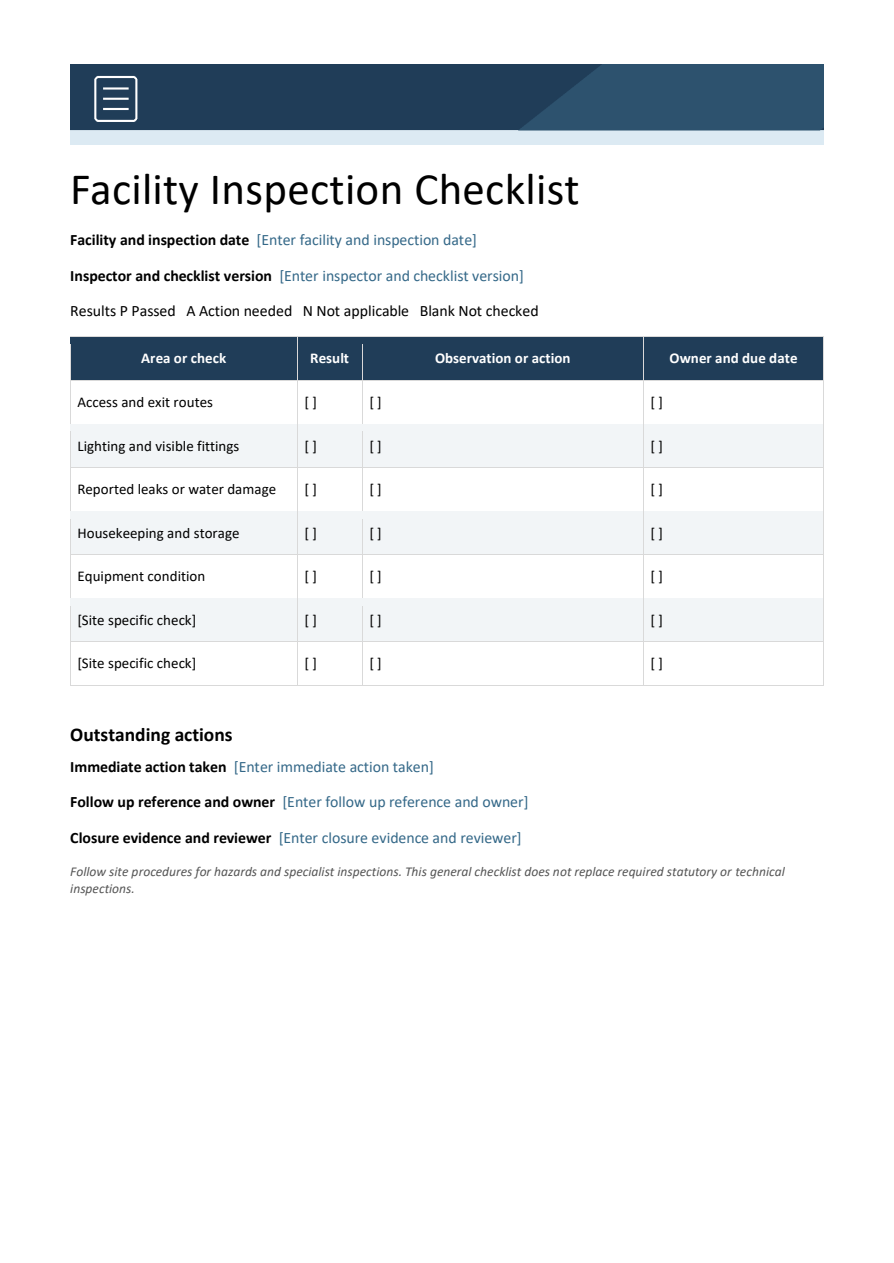
A checklist should lead to action when a check fails. Add this exception sheet so an observed problem has an owner and a review route.
Download the editable Word template
Download Facility inspection checklist (.docx)
Open in Microsoft Word and replace the placeholders. Text and tables are editable; customize the colors and wording for your needs.
Set up the record
- Facility / inspection date: [details]
- Inspector: [name]
- Checklist version: [reference]
| Location / asset | Observation | Immediate action | Follow-up owner | Due date | Closure evidence |
|---|---|---|---|---|---|
| Entrance | [observed obstruction] | [action under site procedure] | [role] | [date] | [verified result] |
| Utility area | [reported leak] | [action under site procedure] | [role] | [date] | [repair and review reference] |
How to use this template
- Describe what was observed and where, without substituting an unsupported diagnosis.
- Follow the site’s process for urgent hazards and restricted areas.
- Close a follow-up only after recording the evidence and responsible review.
Worked example: A blocked exit route is recorded with its location and handled through the site’s immediate response procedure. A later ‘closed’ status identifies who checked the route and when.
Check before use
- Do not treat this worksheet as a replacement for statutory or specialist inspections.
- Keep incomplete checks distinct from passed checks.
- Carry unresolved actions into the next review.
Prioritise facility maintenance by risk and asset
Worked example: For a workplace, a monthly emergency-exit inspection and a quarterly air-filter review should be separate tasks, each with recorded outcomes and follow-up for defects.
Check before use: Follow local building and safety regulations rather than relying on a generic interval. Mark failed checks clearly and record escalation, not just the date an inspection was attempted.
For related resources, see 2 Building Maintenance Schedule Templates and 4 Maintenance Templates.
What’s Included in the Facility Maintenance Checklist Template
Inspection area fields: Space to list each part of the facility that needs to be checked. Condition rating column: A field for noting the current condition of each area or system. Repair needed column: Space to flag items that require follow-up repair or maintenance. Date and inspector fields: Fields for recording when the inspection took place and who conducted it. Priority or urgency field: A field for marking how quickly an identified issue needs to be addressed. Notes section: An area for additional details about specific findings.
Who Should Use These Templates?
Property managers overseeing the upkeep of residential or commercial buildings. Facility maintenance contractors conducting inspections for clients. School and campus administrators maintaining educational facilities. Landlords keeping rental properties in good working condition. Building owners tracking the condition of their infrastructure over time. Maintenance staff documenting routine inspection rounds.
How to Start Using the Template in 3 Simple Steps
Step 1 — Choose a template style: Browse the 3 options below and select the format that best fits your facility. Step 2 — Walk through and inspect: Fill in the condition of each area and flag any needed repairs. Step 3 — Review and schedule follow-up: Prioritize flagged items and schedule the necessary repairs or maintenance.
Facility Maintenance Checklist vs. Preventive Maintenance Schedule
While both documents support building upkeep, a facility maintenance checklist and a preventive maintenance schedule serve different purposes. A facility maintenance checklist is typically used during a single inspection to document the current condition of a building or facility at a specific point in time. A preventive maintenance schedule, by contrast, outlines recurring maintenance tasks that should happen on a regular basis, such as monthly filter changes or annual roof inspections, regardless of whether a problem has been identified. Many facility managers use both together: a checklist to document findings during an inspection, and a schedule to plan the recurring tasks that keep those findings from becoming bigger problems.
Customizing the Template for Your Facility
These templates are designed to be a flexible starting point rather than a fixed format. You can add your building’s specific systems and equipment, adjust the inspection areas to match your facility’s layout, or include additional fields for tracking vendor contacts or repair costs. Since the templates are provided in editable formats, most adjustments take only a few minutes and let you tailor the checklist to fit your particular facility and maintenance process.
Choosing the Right Format
With 3 different templates available, choosing the right one depends on the type of facility and how much detail you need to track. A simpler checklist works well for smaller properties with fewer systems to inspect, while a more detailed template suits larger facilities with extensive building systems and infrastructure. Reviewing each option before committing to one can help you find the layout that best fits your inspection workflow.
Common Mistakes to Avoid
Skipping regular inspections: Infrequent checks increase the risk of small issues becoming major failures. Vague condition notes: Be specific about what was observed rather than writing general comments. Not following up on flagged items: A checklist only helps if identified repairs are actually scheduled and completed. Inconsistent inspection areas: Use the same checklist structure every time for accurate comparisons. Failing to document the inspector: Always record who conducted the inspection for accountability.
Tips to Get the Most Out of Your Facility Maintenance Checklist Template
Conduct inspections on a consistent schedule rather than only when problems are reported. Take photos of flagged issues to document conditions alongside the checklist notes. Prioritize safety-related items above cosmetic or minor concerns. Keep completed checklists on file for tracking conditions over time. Share findings with relevant stakeholders so repairs get scheduled promptly.
Building an Annual Facility Maintenance Plan
Beyond individual inspections, many facility managers find it useful to compile checklist findings into a broader annual maintenance plan that outlines expected repairs, replacements, and upgrades for the year ahead. This kind of planning helps property owners budget realistically for maintenance costs rather than being caught off guard by unexpected major repairs. Reviewing checklist data from previous inspections when building this annual plan also helps identify recurring issues that may point to a deeper underlying problem, such as aging equipment that needs replacement rather than repeated patch repairs.
Coordinating Maintenance With Outside Contractors
Many facility maintenance tasks, particularly specialized ones like electrical, HVAC, or elevator work, require outside contractors rather than in-house staff. Using a facility maintenance checklist to clearly document what needs attention before contacting a contractor helps ensure accurate quotes and reduces the back-and-forth needed to scope the job. Keeping a record of which contractor addressed which checklist item also builds a useful maintenance history that can inform future decisions about which vendors to continue working with.
Using Checklists to Support Tenant and Occupant Safety
Facility maintenance checklists play an important role in supporting the safety of tenants, employees, and visitors who use a building on a daily basis, beyond simply preserving the property’s condition. Regular inspections that specifically flag safety-related concerns, such as faulty exit doors, damaged flooring, or malfunctioning fire safety equipment, help property owners address hazards before they lead to injuries or liability issues. Building this safety-focused review into every routine inspection, rather than treating it as a separate process, helps ensure that these critical items never get overlooked in favor of less urgent cosmetic concerns.
Tracking Maintenance History for Multiple Properties
Property managers or facility contractors responsible for multiple buildings benefit from maintaining a consistent checklist format across every property they oversee, making it easier to compare conditions and prioritize resources. Keeping a centralized record of completed checklists for each property, whether in physical files or a simple digital archive, allows managers to spot patterns across their portfolio, such as which buildings consistently need more attention or which contractors deliver the most reliable repairs. This kind of cross-property tracking becomes increasingly valuable as the number of managed facilities grows, since it turns individual inspection data into a broader resource for planning and budgeting decisions.
Seasonal Considerations for Facility Inspections
Facility maintenance needs often shift with the seasons, making it worthwhile to adjust checklist priorities depending on the time of year rather than using the exact same inspection focus year-round. Fall inspections might emphasize heating system readiness and gutter clearing ahead of winter weather, while spring checks often focus on roof damage from snow and ice, along with landscaping and exterior maintenance. Building this seasonal awareness into a facility’s regular inspection routine helps catch weather-related issues at the point where they’re cheapest and easiest to address, rather than after they’ve caused more extensive damage.
Budgeting for Facility Repairs Identified During Inspection
Once a facility maintenance checklist identifies items needing repair, translating those findings into an actual repair budget is an important next step that’s easy to overlook in the inspection process itself. Categorizing flagged items by urgency and estimated cost helps property owners and managers make informed decisions about which repairs to tackle immediately versus which can be scheduled for a future budget cycle. Building a habit of estimating repair costs at the time issues are first identified, rather than waiting until a formal budgeting period, also helps prevent minor issues from being deprioritized simply because their cost wasn’t documented early on.
Digital vs. Paper-Based Facility Checklists
Whether to use a printed checklist or a digital version on a tablet or phone often depends on the size of the facility and the preferences of the inspection team. A printed checklist remains a simple, reliable option that requires no special equipment and works well for smaller properties or teams that prefer a straightforward paper trail. A digital checklist, on the other hand, can make it easier to attach photos directly to flagged items, share findings instantly with property managers, and build a searchable history of past inspections, which becomes increasingly valuable for larger facilities or portfolios with multiple properties to track.
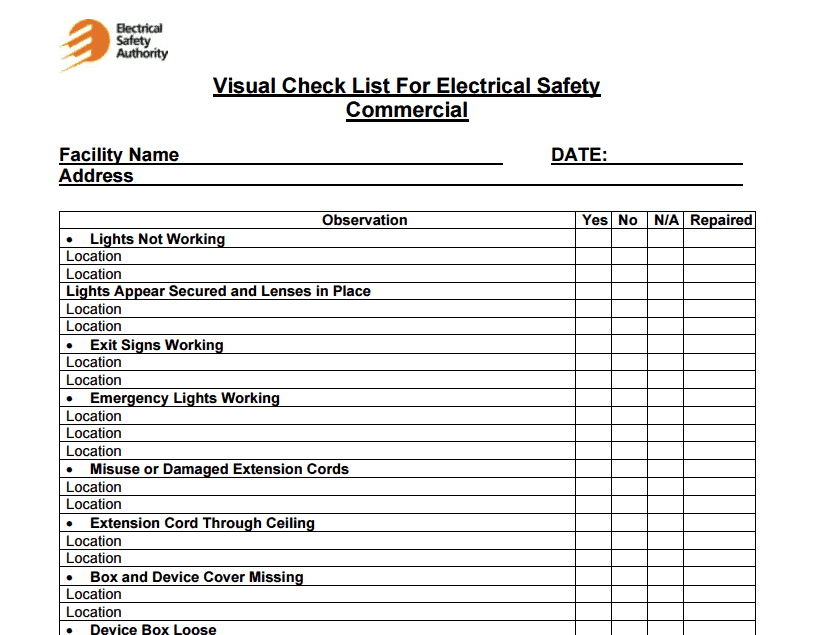
Download facility maintenance checklist templates:
Facility Maintenance Checklist PDF



Frequently Asked Questions
Are these facility maintenance checklist templates free to download?
Yes, all 3 facility maintenance checklist templates on this page are free to download and use.
Can I customize the fields on these templates?
Yes, since the templates are editable, you can add your own inspection areas, systems, and notes fields.
What’s the difference between a checklist and a preventive maintenance schedule?
A checklist documents findings from a single inspection, while a preventive maintenance schedule outlines recurring tasks over time.
Are these templates suitable for large commercial properties?
Yes, the templates can be adapted for facilities of different sizes, from small properties to larger commercial buildings.
Can contractors use these templates for client inspections?
Yes, facility maintenance contractors can use these templates to document inspections and share findings with clients.
How often should I conduct facility inspections?
It’s best to conduct inspections on a regular schedule, such as monthly or seasonally, rather than only once a year.

You must be logged in to post a comment.