
A pro forma budget is a forward-looking estimate, not a historical financial statement. State the planning period, projected income, cost drivers, assumptions and contingency so readers can test alternatives.
Editable downloads and previews
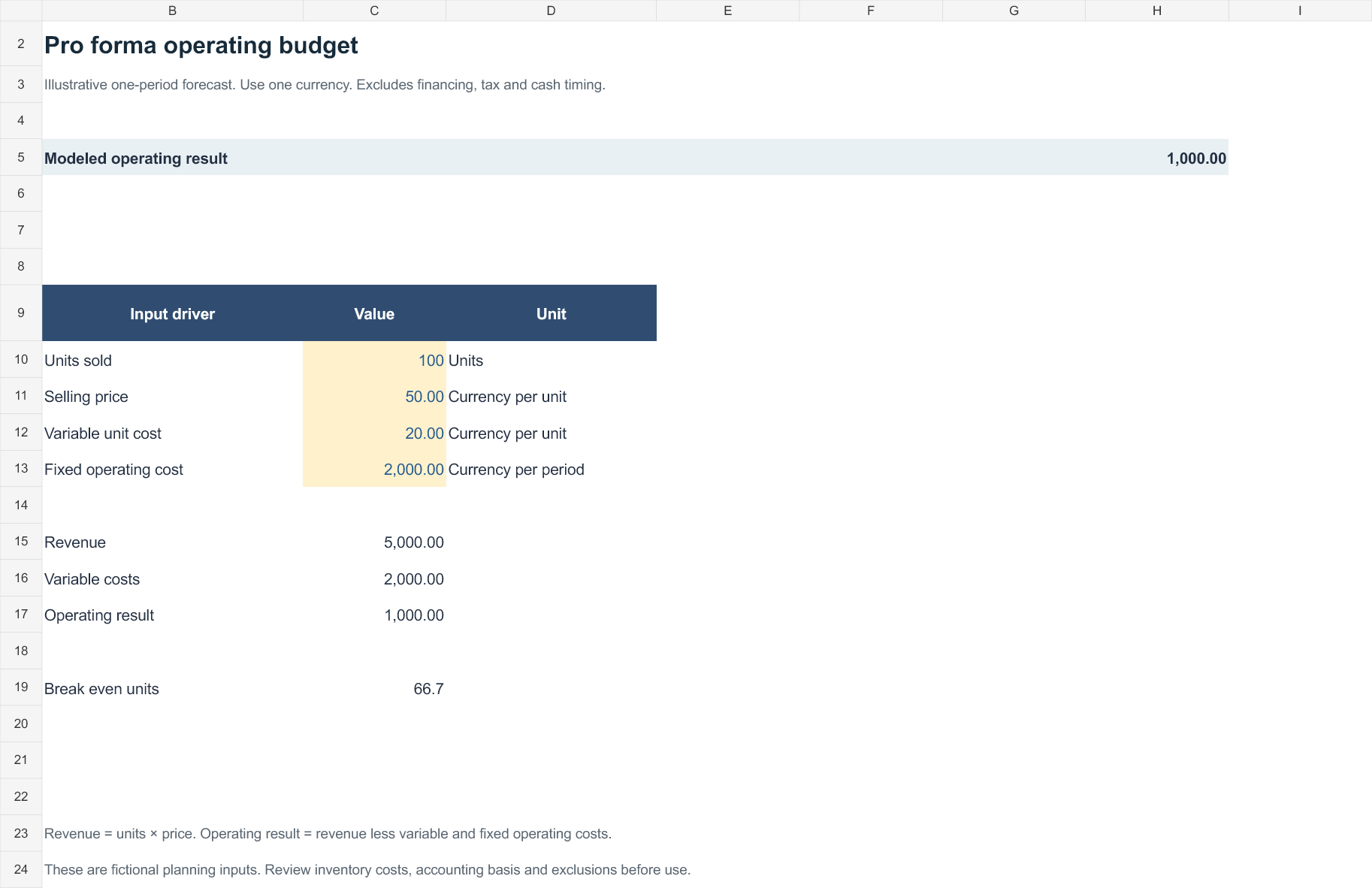
Download the editable Excel workbook
Private, non-commercial use. Download help and usage terms.
Download Pro forma operating budget (.xlsx)
Open in Microsoft Excel. Replace the fictional example data in the highlighted input cells; keep formula cells intact so the summaries update.
More template previews and sources
Use the file links where provided. Links labeled “View original source” open another website; check its current format, availability and terms. A preview image alone is not an editable document.
Template previews and source links
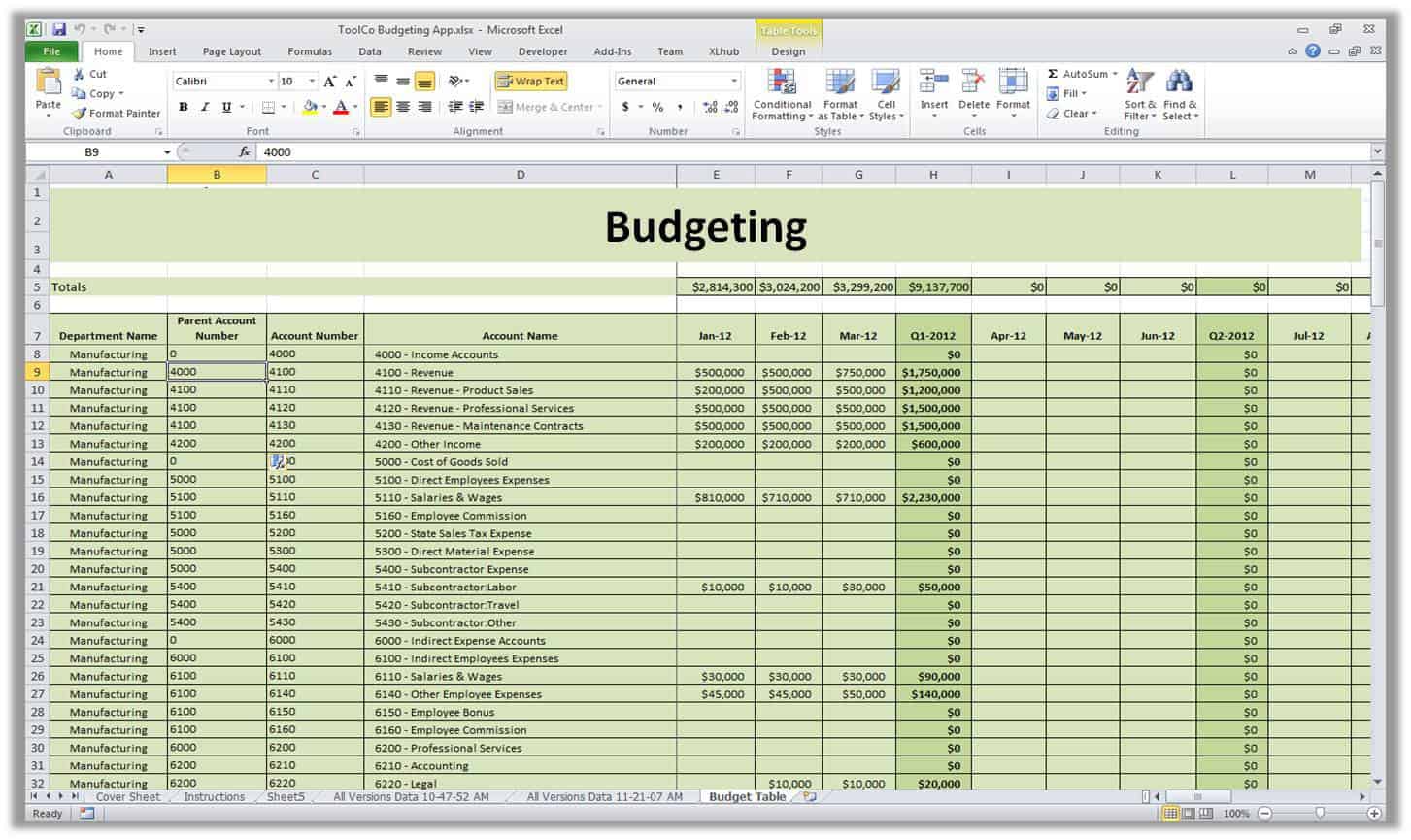
Pro Forma Budget Excel Sheet

 The older external file is unavailable; its preview is retained for reference.
Cash Pro Forma Budget Example

Pro Forma Cash Flow Budget
 The older external file is unavailable; its preview is retained for reference.
Pro Forma Budgeting Template Free
Bonus template: Base and downside pro forma budget worksheet
Show how a forecast changes when one important assumption changes. Use the same cost definitions in each scenario.
Set up the record
- Planning period: [month / quarter]
- Currency: [currency]
- Forecast prepared on: [date]
| Measure | Base case | Downside case |
|---|---|---|
| Units sold | 100 | 80 |
| Price per unit | 50.00 | 50.00 |
| Revenue | 5,000.00 | 4,000.00 |
| Variable cost per unit | 20.00 | 20.00 |
| Total variable cost | 2,000.00 | 1,600.00 |
| Fixed operating costs | 2,000.00 | 2,000.00 |
| Modeled operating result | 1,000.00 | 400.00 |
How to use this template
- Calculate revenue as units multiplied by selling price.
- Subtract total variable costs and fixed operating costs using the same period.
- State items excluded from the model, such as tax, finance costs or one-off spending, when they are not included.
Worked example: A 20% fall in units reduces this simplified operating result from 1,000.00 to 400.00. Revenue falls by 1,000.00, but variable costs also fall by 400.00.
Check before use
- Label forecasts clearly.
- Keep cash timing separate from this profit model.
- Review assumptions against actual results after the period.
Create a pro forma budget from explicit assumptions
Worked example: A community event forecasting 200 tickets at $30 expects $6,000 in ticket revenue before fees or cancellations. A downside case of 150 tickets yields $4,500, which may require reducing discretionary spending.
Check before use: Document the source of each assumption and keep forecast, approved budget and actual spending in separate columns. Do not present projected figures as guaranteed outcomes.
For related resources, see 14+ BEST Event Budget Templates [EXCEL, PDF, WORD] and 5 Financial Plan Templates Excel.
What’s Included in the Pro Forma Budget Template
- Projected revenue fields: Space to estimate expected income from sales or services.
- Projected expense fields: Columns for anticipated costs across different categories.
- Net income calculation: Areas that calculate projected profit or loss based on the entered figures.
- Time period fields: Space to break projections down by month, quarter, or year.
- Assumptions section: An area to document the reasoning behind key projections.
- Comparison fields: Space to compare projected figures against actual historical performance.
How to Start Using the Template in 3 Simple Steps
- Step 1 — Choose a template style: Browse the the options below and select the layout that fits your forecasting needs.
- Step 2 — Enter historical data and assumptions: Use past performance and reasonable assumptions to build your projections.
- Step 3 — Review and adjust regularly: Update the budget as actual figures come in to keep projections realistic.
Pro Forma Budget vs. Actual Budget
While the two documents are closely related, a pro forma budget and an actual budget serve different purposes. A pro forma budget is a forward-looking projection built on assumptions and historical trends, used to estimate what future income and expenses might look like. An actual budget, or an actual financial statement, records what has genuinely happened during a completed period. Comparing the two after the fact, projected figures against actual results, helps businesses refine their forecasting accuracy for future periods.
Using a Pro Forma Budget to Support a Loan or Investment Request
Lenders and investors routinely ask for a pro forma budget as part of evaluating a funding request, since it demonstrates that a business has thought carefully about its financial trajectory rather than simply asking for money without a plan. A well-constructed pro forma budget that clearly documents its assumptions and ties projections back to realistic historical data tends to carry more credibility with financial decision-makers than one built on vague guesswork. Taking the time to build a defensible, well-documented forecast before approaching lenders or investors can meaningfully improve the chances of securing favorable financing terms.
Building Multiple Scenarios into Your Forecast
A single pro forma budget built around one set of assumptions can give a false sense of certainty about the future, which is why many experienced planners build out best-case, worst-case, and most-likely scenarios side by side. Comparing how the business would perform under each scenario helps identify which assumptions have the biggest impact on the bottom line and where contingency planning might be most valuable. This kind of scenario planning is particularly useful when presenting projections to stakeholders, since it shows a realistic range of outcomes rather than a single, potentially misleading number.
Revisiting and Refining Your Pro Forma Budget Over Time
A pro forma budget isn’t meant to be created once and then set aside, its real value comes from being revisited regularly and compared against actual results as they come in. Tracking how far actual performance deviates from projections, and understanding why those deviations occurred, helps sharpen the assumptions used in future forecasts and makes each successive budget more accurate than the last. Businesses that treat pro forma budgeting as an ongoing, iterative process rather than a one-time exercise tend to develop much stronger forecasting instincts over time.
Common Uses for a Pro Forma Budget Beyond Financing
While securing a loan or investment is one of the most common reasons businesses build a pro forma budget, the exercise proves valuable in a range of other situations as well. Evaluating whether to launch a new product line, open a second location, or take on a major new hire all benefit from the same kind of structured forecasting, since each decision carries financial implications that are easier to weigh with clear projections in hand. Even businesses with no immediate need for outside financing often find that the discipline of building a pro forma budget annually sharpens their overall financial awareness and decision-making throughout the year.
Balancing Detail and Simplicity in Your Projections
It’s tempting to build an extremely detailed pro forma budget with dozens of line items and granular assumptions, but overly complex forecasts can become difficult to maintain and just as difficult to explain to others reviewing them. Striking a balance between enough detail to be genuinely useful and simple enough to update and communicate clearly tends to produce a more practical forecasting tool than either extreme. Starting with broader categories and adding detail only where it meaningfully improves accuracy is often a more sustainable approach than trying to forecast every possible line item from the outset.
Frequently Asked Questions
Are these pro forma budget templates free to download?
Yes, the templates on this page are free to download and use.
Can I customize the fields on these templates?
Yes, since the templates are editable in Excel, you can adjust categories, time periods, and formulas to fit your business.
What’s the difference between a pro forma budget and an actual budget?
A pro forma budget is a forward-looking projection, while an actual budget records what genuinely happened during a completed period.
Do lenders require a pro forma budget for loan applications?
Many lenders and investors expect to see a pro forma budget as part of evaluating a financing or investment request.
How often should I update my pro forma budget?
It’s best to review and revise the budget quarterly to keep projections aligned with actual performance.
Can these templates be used for a new business with no historical data?
Yes, though projections for a new business rely more heavily on market research and reasonable assumptions instead of past figures.

You must be logged in to post a comment.