
A merchandise return form should identify the product or SKU, original sale, quantity, reason for return, condition, requested remedy and authorisation. The retailer also needs to record what happened to the returned stock.
Bonus template: Return authorization and stock-disposition form
Use this form to connect a customer’s return request to the original sale and the action actually taken. A requested refund and a completed refund are different statuses.
Download the editable Word template
Download Merchandise return authorization (.docx)
Open in Microsoft Word and replace the placeholders. Text and tables are editable; customize the colors and wording for your needs.
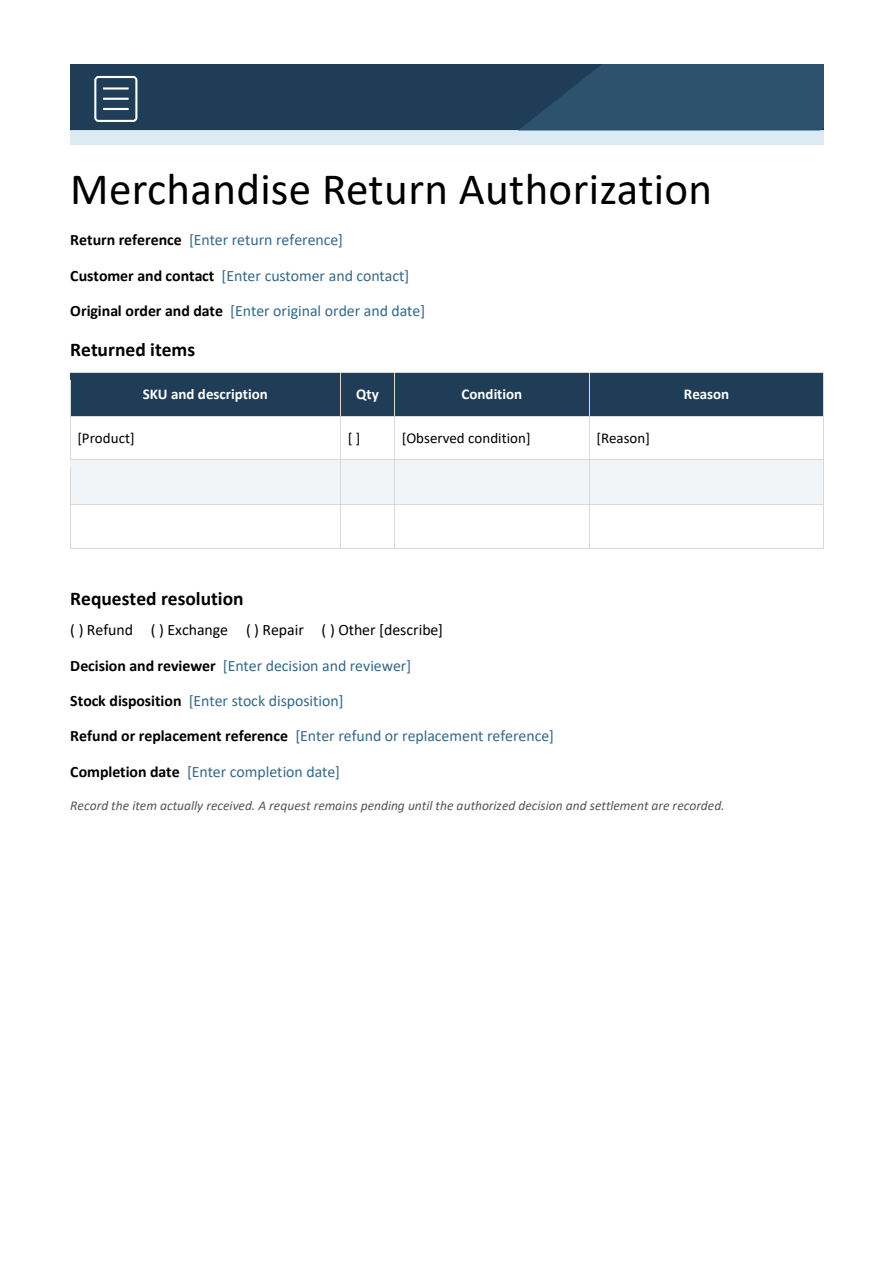
Set up the record
- Return reference: [number]
- Original order / invoice: [reference]
- Customer contact: [minimum required detail]
| Field | Entry |
|---|---|
| Product / SKU and quantity | [details] |
| Reason and observed condition | [facts] |
| Customer request | [refund / exchange / repair / other] |
| Decision and authorized reviewer | [decision; name; date] |
| Stock disposition | [restock / quarantine / repair / other] |
| Settlement reference and date | [actual refund or exchange reference] |
How to use this template
- Check the original sale and record the item actually received.
- Apply the retailer’s current policy and applicable requirements through the authorized review process.
- Update stock and settlement records separately so the same returned item is not refunded or restocked twice.
Worked example: A customer requests an exchange for one damaged mug. The received mug is recorded as damaged stock; the replacement dispatch and any refund status are recorded as separate actions.
Check before use
- A return request is not approval.
- Record the quantity received, not just the quantity requested.
- Keep payment-card information out of the form.
Document returned goods and the decision on credit
Worked example: A customer returning two defective chargers from an order of five can reference the original invoice, note the fault, and specify whether replacement or refund has been approved.
Check before use: Record inspection and refund status separately; a submitted return request is not automatically an approved credit. Respect consumer rights and any applicable return policy.
- Saves design time: A ready-made layout means you can focus on processing returns instead of designing a form from scratch.
- Keeps records organized: Clearly labeled fields for customer and purchase details reduce confusion when reviewing return requests.
- Speeds up processing: A complete, well-organized return form helps staff process refunds or exchanges faster.
- Reduces errors: Structured fields help ensure all necessary information is captured for each return.
- Maintains customer trust: A professional return process reassures customers that their request will be handled properly.
- Free and reusable: Download once and reuse the same template structure for every future return.
For related resources, see 3 Excel Product List Templates and 5 Printable Payment Record Templates.
What’s Included in the Merchandise Return Form Template
- Customer information: Fields for the customer’s name, contact details, and address.
- Purchase details: Space to record the date of purchase and the sales receipt number for reference.
- Item description: A field describing the goods being returned, including quantity and product details.
- Reason for return: Space to note why the item is being returned, such as damage or dissatisfaction.
- Preferred resolution: A field indicating whether the customer wants a refund, exchange, or store credit.
- Signature and date: Space for the customer or staff member to sign and date the form.
Who Should Use This Template?
- Retail store owners processing in-person return requests from customers.
- Online sellers managing mail-in returns and exchanges.
- Customer service teams documenting return requests for tracking purposes.
- Small business owners establishing a formal, professional return process.
- Warehouse and inventory staff processing returned goods for restocking.
- Wholesale distributors handling returns from retail partners.
How to Start Using the Template in 3 Simple Steps
- Step 1 — Download the template: Click the download button below to get the Word file.
- Step 2 — Add your company details: Insert your company name, logo, and any specific return policy information.
- Step 3 — Print or share: Print copies for in-store use or share the form digitally with customers.
Merchandise Return Form vs. Return Authorization Form
While both documents relate to product returns, a merchandise return form and a return authorization form serve slightly different purposes. A return authorization form is typically issued by the seller to approve a return before it’s shipped back, often including a specific authorization number required for processing. A merchandise return form, by contrast, is usually completed by the customer to document the details of the return itself. Many businesses use both together: an authorization form to approve the return in advance, and a merchandise return form to record the specifics once the item arrives back.
Customizing the Template for Your Business
This template is designed to be a flexible starting point rather than a fixed format. You can add your company logo, adjust the fields to match your specific return policy, or include additional notes about restocking fees or time limits. Since the template is provided in editable Word format, most adjustments take only a few minutes and let you tailor the form to fit your business’s specific return process.
Choosing the Right Format
This form is provided in Microsoft Word format, making it easy to edit the text directly and print copies for in-store or mail-in use. Since Word documents are widely compatible, you can open and customize the template on most computers without needing specialized software. Once personalized, the form can also be saved as a PDF for easy digital sharing with customers via email.
Common Mistakes to Avoid
- Missing purchase details: Always include the receipt number and purchase date to verify the original transaction.
- Vague reason for return: Encourage customers to provide specific details about why they’re returning an item.
- Skipping the signature: A signed form helps confirm the customer’s request and protects the business.
- Inconsistent processing: Use the same form and process for every return to keep records consistent.
- Not tracking return reasons: Reviewing common return reasons over time can reveal product quality issues.
Tips to Get the Most Out of Your Merchandise Return Form Template
- Keep copies of every return form for your records and for resolving any future disputes.
- Review return trends periodically to identify products with recurring issues.
- Train staff on the return process to ensure forms are completed consistently and accurately.
- Communicate your return policy clearly alongside the form so customers know what to expect.
- Digitize completed forms for easier searching and long-term record-keeping.
Building a Clear and Fair Return Policy
A merchandise return form works best when paired with a clear, well-communicated return policy that customers can easily understand before making a purchase. Specifying details such as the return window, condition requirements for returned items, and whether receipts are required helps set proper expectations and reduces disputes at the time of return. Businesses that clearly display their return policy, both in-store and online, often see fewer customer complaints and a smoother overall return process.
Managing Returns for Online and Mail-In Purchases
For online sellers, managing merchandise returns requires additional considerations compared to in-person retail, such as providing clear shipping instructions and tracking returned packages. Including a printable version of the return form with online orders, or making it easily downloadable from a website, helps streamline the process for customers who need to send items back. Tracking return shipments and matching them to the correct return form upon arrival helps prevent processing delays and lost items.
Using Return Data to Improve Products and Service
Beyond simply processing individual returns, the information collected on merchandise return forms can offer valuable insight into product quality, sizing issues, or customer service gaps. Reviewing return reasons in aggregate over time can help businesses identify patterns, such as a specific product that’s frequently returned due to a defect or a common misunderstanding about product specifications. Acting on these insights, whether by improving product descriptions or addressing a manufacturing issue, can help reduce future return volume and improve overall customer satisfaction.
Training Staff to Handle Returns Professionally
How staff handle the return process can significantly influence whether a customer remains loyal to a business even after a negative purchase experience. Training employees to process returns efficiently, using the merchandise return form consistently, while also treating customers with patience and understanding, helps turn a potentially frustrating situation into a positive service interaction. Businesses that invest in return-process training often find that customers are more likely to make future purchases, even after having to return an item, simply because the process felt fair and well-handled.
Handling Returns for Damaged or Defective Merchandise
Returns involving damaged or defective merchandise often require extra documentation, such as photos of the damage or a description of the specific defect, to support the customer’s claim and inform any conversations with suppliers or manufacturers. Recording these details clearly on the merchandise return form helps businesses track which products are experiencing quality issues and provides useful evidence if a claim needs to be filed with a manufacturer or supplier. Handling damaged item returns promptly and without excessive friction also tends to leave a stronger positive impression on customers than a slow or complicated process.
Integrating Return Forms With Inventory Management
Once a return is processed, connecting the merchandise return form to inventory records ensures that returned items are properly accounted for, whether they’re restocked, discarded, or sent back to a supplier. Businesses that treat returns as part of their broader inventory workflow, rather than a separate process, tend to maintain more accurate stock counts and avoid discrepancies between recorded and actual inventory. Keeping a clear link between each return form and the corresponding inventory adjustment also makes it easier to audit return-related inventory changes if questions arise later.
Setting Reasonable Time Limits for Returns
Deciding on a reasonable return window, such as 14, 30, or 60 days from purchase, is an important part of any return policy that the merchandise return form should reflect through a purchase date field. A window that’s too short can frustrate customers and damage trust, while one that’s too long may create inventory and accounting challenges for the business. Many businesses find that clearly stating the return window at the point of sale, and reinforcing it on the return form itself, helps minimize confusion and disputes when customers do need to make a return.
See Merchandise Return Form Templates Below
Merchandise Return Form Sample


Frequently Asked Questions
Is this merchandise return form template free to download?
Yes, this template is free to download and use.
Which file format is this template available in?
This template is available in Microsoft Word format.
Can I customize the fields on this template?
Yes, since the template is fully editable, you can add your logo and adjust fields to match your specific return policy.
Is a merchandise return form the same as a return authorization form?
No, a return authorization form approves a return in advance, while a merchandise return form documents the details of the return itself.
Can this template be used for online sellers?
Yes, this template works well for both in-store returns and mail-in returns from online purchases.
What information should be included on a merchandise return form?
A complete form should include customer details, purchase information, item description, reason for return, and a signature.

You must be logged in to post a comment.